Connecting rod design for the Toyota M15A
A Python design study of the connecting rod for the 1.5 litre three cylinder engine of the Toyota Yaris Mk4: kinematics, buckling, fatigue, bearings and bolts, with a dimensioned ISO GPS drawing.
- Role
- Author
- When
- August 2026
- Stack
- Python, NumPy, SciPy, Matplotlib, FreeCAD, LaTeX
Context
The connecting rod links the piston to the crankshaft. It is pushed by combustion pressure, pulled by the inertia of the piston at every revolution, and bent sideways as the crank turns, millions of times over its life. Sizing one is a classic mechanical design exercise. I took the Toyota M15A, the 1.5 litre three cylinder engine of the Yaris Mk4, as the reference and wrote the whole calculation as a reproducible Python package instead of a spreadsheet.
What the code does
Starting from the engine data (bore 80.5 mm, stroke 97.6 mm, 145 mm rod length, 6,600 rpm), a pipeline of modules computes:
- Kinematics and forces over the full 720 degree four stroke cycle: piston displacement, speed and acceleration, gas force from a modelled pressure curve, reciprocating inertia, the resulting axial load on the rod, crank torque and side thrust.
- Shank section: an I-beam cross section, with area, second moments of area and section moduli.
- Buckling in both planes with Euler, Rankine-Gordon and Tetmajer formulas.
- Fatigue for infinite life with a Haigh diagram and the modified Goodman criterion, including surface finish, size and notch factors.
- Bearings: contact pressure and the pv factor at the small and big end.
- Bolts: preload, tightening torque and safety factors following VDI 2230.
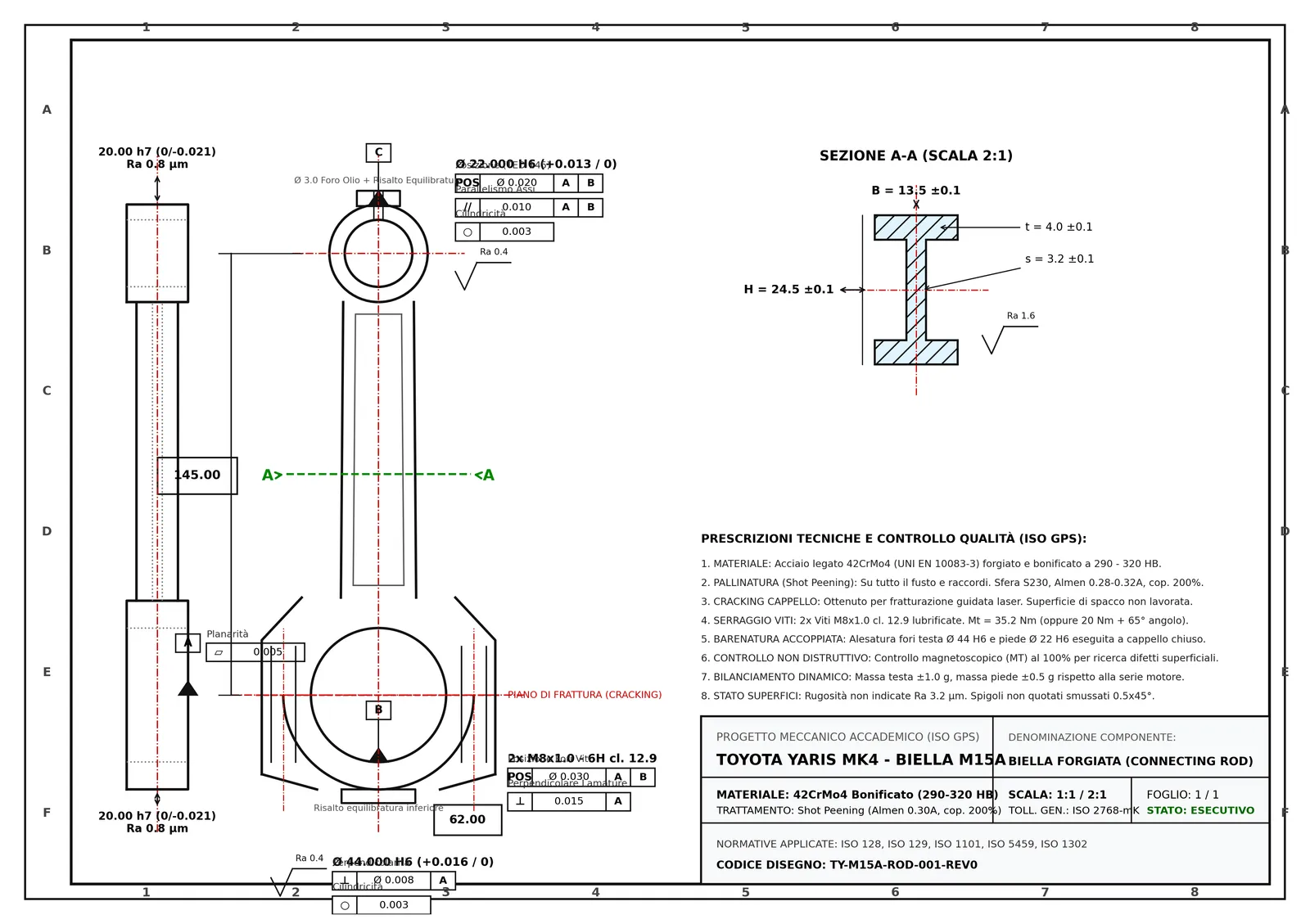
A materials database compares steels (42CrMo4, 39NiCrMo3, 34CrNiMo6) and a titanium alloy. The final geometry is exported as JSON and CSV for a parametric FreeCAD macro, and drawn as a dimensioned 2D drawing with ISO GPS tolerances. A pytest suite covers kinematics, shank sizing, buckling, fatigue, bolts and materials, and a LaTeX report collects the results.
Limitations
This is a study, not a manufacturer's design. Bore, stroke and rod length are public figures; the pressure curve and the masses (piston group 0.36 kg, rod 0.42 kg) are modelled or estimated, so the safety factors are only as good as those assumptions. Nothing here was validated with physical tests on a real part.